Contents
Most students have experienced the frustration of moving forward in a lesson before they were ready, or waiting while others catch up, creating persistent gaps in understanding. With AI, every learner can progress at their own pace, receiving tailored support that once required hours of individual teacher time. You now have the tools to extend your reach, offering targeted interventions at scale without sacrificing depth or connection.
The Tipping Point of Traditional Instruction
One-size-fits-all teaching has reached its limits in an era where student needs vary widely. Standardized pacing ignores learning gaps that compound over time, leaving some behind while others stagnate. When every learner progresses at a different rate, the traditional model falters under its own rigidity, unable to adapt in real time.
The myth of the median student
Average performance is a statistical fiction in real classrooms. No student learns exactly on pace with an imagined middle, and designing for this phantom student leaves advanced learners unchallenged and struggling students unsupported. Real students exist in a spectrum, not a bell curve.
The scarcity of human hours
You have only so many minutes in a day to meet with students individually. Even dedicated teachers cannot scale personalized attention across 30 or more learners without support. Time is the most constrained resource in education, not knowledge or intent.
Consider a high school math teacher managing four classes of 28 students. That’s 112 individuals, each with unique misconceptions and learning rhythms. Spending just five minutes per week in one-on-one review would require nearly ten uninterrupted hours-time that doesn’t exist between grading, planning, and instruction. Without augmentation, personalization remains a luxury few can afford.
The Algorithmic Apprentice
An AI tutor works beside you, quietly analyzing each student’s pace, errors, and engagement in real time. It doesn’t replace your judgment but extends your reach, flagging when a student stalls on quadratic equations or rushes through grammar drills. This silent partner learns as students learn, adapting content before you even notice the struggle.
Decoding individual learning patterns
Every click, pause, and correction a student makes feeds a model that maps their cognitive habits. You see not just who is behind, but why-whether a student consistently misapplies verb tenses due to pattern confusion or rushes through reading comprehension. One high school math teacher discovered that 60% of her class skipped problem-solving steps, a habit invisible in traditional grading.
Instantaneous feedback loops
When a student solves a physics problem incorrectly, the system responds in seconds with a tailored hint, not just a red mark. Immediate correction prevents misconceptions from solidifying, turning mistakes into pivot points. A student at a rural charter school revised her approach to circuit diagrams three times in one session, each attempt guided by real-time prompts.
These feedback mechanisms operate on a cycle too fast for human monitoring, yet their design reflects pedagogical intent. The AI doesn’t simply correct-it probes, asking guiding questions that mirror Socratic dialogue. If a student misidentifies a metaphor, the response might ask what the image suggests emotionally, nudging deeper analysis. This mimics the back-and-forth of effective tutoring, scaled to thirty learners at once.
Dismantling the Classroom Factory
Industrial-era classrooms were built for uniformity, moving students through fixed schedules and standardized content at the same pace. You no longer need to treat learning as a mass production line where individual needs get lost. Personalized pacing and targeted interventions disrupt this outdated model, allowing each student to progress based on mastery rather than minutes spent in a seat.
Moving beyond the assembly line
Time-based progression forces fast learners to wait and struggling students to fall behind. You replace this rigidity with dynamic pathways, where a student mastering quadratic equations quickly advances while another receives tailored practice. Learning becomes responsive, not rigid, mirroring how skills develop in real-world contexts.
Scaling intimacy through software
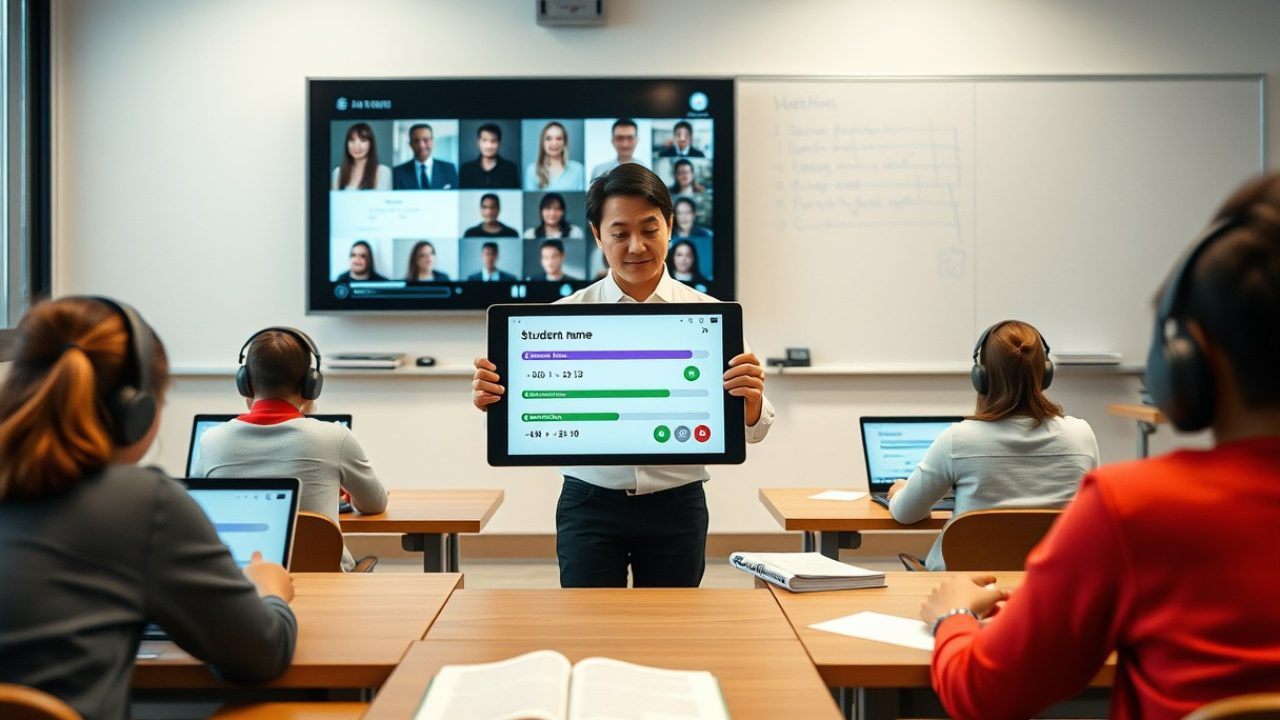
One-on-one tutoring has long been reserved for the privileged few due to cost and logistics. You now use AI tutors that simulate individual attention, offering immediate feedback and adaptive questioning. A single teacher can oversee dozens of personalized learning threads simultaneously, making high-touch instruction accessible at scale.
Imagine an eighth grader receiving customized explanations in real time after misapplying a grammar rule, while another practices fraction division with scaffolded hints that adjust based on each attempt. These interactions, once possible only in private sessions, now occur across an entire class without sacrificing depth. The software doesn’t replace you-it amplifies your presence, extending your reach into every student’s unique learning moment.
The Psychology of Adaptive Progress
Adaptive learning systems respond to your students’ cognitive patterns, adjusting content in real time to maintain optimal challenge. When difficulty aligns precisely with ability, engagement deepens and mental fatigue decreases. Explore how Scaling AI tutoring to enhance personalized learning in schools transforms static curricula into dynamic growth pathways.
Flow states in digital environments
Students enter flow when tasks stretch their skills without overwhelming them. AI identifies this balance by analyzing response timing and accuracy, then sustains it by calibrating each new exercise. In these moments, distractions fade and concentration becomes effortless, mirroring the focus seen in expert musicians or athletes during peak performance.
Precision in skill acquisition
Every interaction with an AI tutor generates data on mastery gaps, allowing pinpoint interventions. Instead of reteaching entire lessons, you can address isolated misconceptions-like a student confusing verb tenses in Spanish-through targeted practice that reinforces correct application immediately.
Consider a student struggling with inferential reading comprehension. Rather than assigning generic passages, the AI delivers texts calibrated to their lexile level and embeds questions that isolate specific subskills, such as identifying implied motives. Each response shapes the next prompt, creating a feedback loop that sharpens cognitive precision over time, similar to how elite tutors scaffold understanding through tailored questioning.
The Teacher as Strategic Orchestrator
You shift from constant content delivery to guiding how learning unfolds across individuals and groups. AI handles pattern recognition and routine feedback, freeing you to interpret student needs, adjust pacing, and design meaningful interventions. Your expertise determines when to challenge, support, or redirect-transforming raw data into human insight.
Offloading administrative cognitive load
Grading quizzes, tracking progress, and logging behavior no longer consume your mental bandwidth. Automated systems manage repetitive tasks with consistency, reducing decision fatigue. You regain hours once lost to paperwork, allowing sharper focus on instructional design and student relationships.
Enhancing high-value interactions
With routine tasks automated, you engage students in deeper conversations, targeted mentoring, and real-time problem solving. Face-to-face time shifts from logistics to inquiry, where your presence amplifies critical thinking and emotional support. These moments become the cornerstone of personalized growth.
Consider a student struggling with fraction equivalence: instead of reviewing the same worksheet with ten learners, you use AI-generated insights to identify three distinct misconceptions across the class. For one, you build a visual model using manipulatives; for another, you connect the concept to music rhythms. Each intervention is precise, informed, and human-led, turning generalized instruction into tailored cognitive scaffolding.
Democratizing the Socratic Method
AI enables you to replicate the Socratic method at scale, guiding students through disciplined questioning that challenges assumptions and deepens understanding. Where once only elite institutions could sustain such dialogue-intensive instruction, every student now accesses a responsive, inquiry-driven experience tailored to their reasoning level.
Universal access to elite methods
Every student, regardless of zip code or school funding, can engage in the same rigorous question-and-response patterns long reserved for top-tier private schools. This equalization of pedagogical quality means cognitive development is no longer gated by institutional privilege but driven by individual engagement.
The end of the educational lottery
Geography and socioeconomic status no longer determine whether you experience transformative teaching. AI-powered dialogue systems deliver consistent, high-quality reasoning practice to rural classrooms, underfunded districts, and overcrowded schools, dismantling the randomness of who gets access to intellectual mentorship.
A student in a remote town with a single under-resourced teacher can now receive probing, adaptive questions that mirror those from a Harvard seminar. The AI identifies gaps in logic, prompts clarification, and sustains inquiry without fatigue, ensuring depth of thought is cultivated uniformly, not by chance. This is not augmentation-it is redistribution of intellectual opportunity.
Summing up
You guide each student through tailored learning paths made possible by AI’s ability to adapt in real time. A high school math teacher in Arizona, for instance, uses an AI tutor to assign differentiated problem sets that adjust based on individual performance, freeing class time for deeper discussion. Your role shifts from lecturer to mentor, identifying gaps, motivating progress, and applying human insight where it matters most. This integration scales personalized attention without replacing the teacher’s expertise.